Sunday, January 2, 2011

How to Make a Quilt

After a long and fruitful conversation about quilts with my Aunt Heidi last night, I decided to post some pictures of my creations so that she and everyone else might see my handiwork. The longer I work on this, the more I consider myself a "Quilter," but I know I still have a long way to go before I become Accomplished at this art. Heidi says that my great-grandmother (her grandmother), whom we called Boodie, always wished she'd taken up quilting, and had stored away yards and yards of scraps in anticipation of that goal, but it never got used. Also, her mother, my great-great grandmother, was an excellent quilter and some of her work is left unfinished, never to be taken up by Boodie, though still kept ready to go in those boxes as well. My desire to learn quilting is fueled by an intense admiration of all the craft work Boodie did do, once upon a time, and a desire to emulate the cozy beds at her house with their hodge podge of sheet sets and scrappy quilts (which I now know were made by my great-great grandmother!).

First Quilt
My first quilt ever began with a quilting class at Santa Barbara City College. Little did I know then that our instructor was having us design our quilts in pretty much the most expensive way possible (short of buying Egyptian Cotton 1000 thread-count fabric!), but the results are nothing to sneeze at and the the techniques I learned are the true value.

The six blocks of my quilt.

We made "sampler quilts." A sampler quilts feature a variety of different traditional quilt blocks, and are unified by the repeating colors in each block. My colors are red and gold, which are derived from the "Focus Fabric," and are in turn used in each block and in the border of the quilt (see below). Each block also has a "background fabric" (in this case, it's off-white) that also serves as a unifying element. I had seen quilts that didn't use a background fabric, and I thought they weren't as pretty as those that did.

Here are the blocks with borders added and the setting in process of being attached.

I ended up adding dark brown borders around each block because the fabric for the setting was so busy that it muddled the colors and patterns of the blocks themselves. It's funny how that works out. You never know until you see it laid out and ready to go.

This is the assembled quilt top. Note the three reds (a dark, medium and light) and three golds (a dark, medium and light). In putting together the quilt top, I took care to arrange the blocks so that no one block or pair of blocks is constantly drawing the viewer's attention. Notice that two blocks have an octagon shape in them. These have deliberately been placed separate from each other. The same goes for the two blocks that have heavy amounts of pink. Finally, I placed my two favorite blocks in the middle row, because I love them.

My two favorite blocks, traditionally called "Rosebud" and "Cat's Cradle"


Fast forward a year later. Here I have laid out the "quilt sandwich": backing, batting and top.


First it is pinned.


Then it is basted with long, running stitches.

Then I hand quilted it. No need to shudder or cringe on my behalf; I quite enjoyed it and became pretty adept at making those close, tiny stitches that are the mark of good quilting (see below). This part took me about a month and a half, working a few hours every day while watching The Wire on DVD. I developed a tough little callous on my left index finger from catching the needle as it came through the quilt thousands of times. Certainly a mark of pride, for me.


Here is the back of the quilt, now finished. My quilting pattern was to just "stitch in the ditch" as they say. Rather than attempt anything more complex, my quilting lines just follow along right next to the seams between pieces of the quilt top. This is simpler and faster than curvy designs and I like the effect on the back, which now carries an echo, or perhaps a shadow, of the pieced design on the front of the quilt.

Here are my quilting stitches up close. According to my quilting book, an average quilter can do 6 stitches per inch, an "Accomplished" quilter can do 8, and a "microquilter" can do 14! After weeks and weeks of practice, I was doing between 6-8 stitches per inch. Evenness of stitches is more important than how close-packed they are, though.


Quilting has ruined store-bought quilts for me. Now I examine bedspread quilts in places like Pottery Barn and Bed, Bath and Beyond, and I am aghast and appalled. Many of these quilts, which they have the gall to charge over $100 for sometimes, have "quilting" stitches that are half an inch long and spaced 3 or 4 inches apart. It looks like they forgot to take out their basting! This is a travesty on the art of quilting.


Second Quilt
My second quilt is a "jelly roll" quilt, meaning that most of my fabric will come from two "jelly rolls," which is the trademarked term that the Moda fabric company gives to bundles of fabric strips. Each jelly roll has about 40 strips, each 44-inches long (the width of most fabric yardage) and 2 1/2 inches wide. A jelly roll usually contains one strip from each kind of fabric in a given line. My jelly rolls are from the "Park Avenue" line, and they were on sale.

A jelly roll in the wild

Alas, two jelly rolls is not quite enough fabric for the quilt I want (queen-sized bedspread with generous drop and pillow tuck: 96 x 102 inches!). So I collected a few more quarter-yards of fabric, which you can see folded up below.

All the fabric for my quilt top (save the border)

Fabric close-up

My design is intended to give the appearance of random piecey-ness to my quilt top while still being simple and fast to cut and piece. Only two size pieces will be used: 3 x 2 inches and 10 x 2 inches.

Cutting a 3 x 2 inch piece (they're actually 3.5 x 2.5 so there can be a 1/4-inch seam allowance)

Here is all the fabric for the top of my quilt

This is 720 3.5" x 2.5" pieces, 144 10.5" x 2.5" strips, and 270 2.5" x 2.5" squares (for a pieced inner-border). It will yield 72 10 x 10 inch squares. So far so good! I'm in the middle of sewing together the 3 x 2 inch pieces. My wonderful housemate has a sewing machine that she neglects terribly and so is happy to let me use it.

For an idea of what this quilt will look like finished, check out this artist's Etsy listing for her own jelly roll quilt. Notice the lines of shorter pieces separated by longer strips. My quilt will be much larger than this one.

Monday, August 23, 2010

We Do Still Live in America, Right?

Click this text to read a news article about opposition to mosques that aren't near Ground Zero.

This makes me so many different kinds of sick. In this day and age, I should not have to make an accounting of all the reasons how this goes against everything this country is actually about. So I won’t. And, further, I don’t know if it’s more troubling or more comforting to remember that this kind of xenophobia has existed since the founding of our country anyway (anti-Catholic, anti-Semitic, anti-Mormon).

Then there was the polite yet firm debate I had with my wishes-she-were-as-liberal-as-she-thinks-she-is grandmother yesterday. It was spurred by her “innocent” mention of some controversy over a young Muslim woman who was told she couldn’t wear her “burqa” while working at Disneyland (she used the word burqa, which is telling, because the young lady in question doesn’t wear a burqa, she wears a hijab) Her rhetorical question: “Why do Muslim women insist on coming here and wearing those awful robes that are so obviously foreign and “un-American” when they know it’s not what we do here.” (Subtext: …because it makes me uncomfortable). My left leg was bouncing pretty frantically as I tried to phrase my responses as diplomatically and calmly as possible, but it’s hard to be diplomatic when the other participant in your conversation doesn’t admit that she’s actually saying what she’s actually saying.

Me: “So you think people who come here should conform to our styles of dress. Is conformity an American value?”

Grandma: “No, I didn’t say they have to conform. They just should realize that when they come here they should behave like Americans. They shouldn’t wave their flag around and refuse to give up the customs of their home country.”

My non-rhetorical response to her original question: “They come here and dress that way because it’s part of how they practice their religion, and we told them that they may freely practice their religion here. It just so happens that this particular Islamic dictum has a very obvious physical presence. We don’t tell Christians they can’t build their churches with giant crosses on top that can be seen for miles around, do we?”

Her argument boils down to: This behavior (wearing a hijab, niqab etc) makes me uncomfortable, so the other person should stop it. Never mind that this behavior has absolutely no direct effect on her and it in no way threatening, dangerous, manipulative, or coercive, it’s just so “in her face.” This is plainly ludicrous. I hope she comes to realize it someday. It’s hard to teach an old grandmother new tricks, and she’s got some pretty ingrained habits to break. I wish her luck with that.

And I hope this country can get its head out of its ass.

The Most Isolated Man in the World

This article is cool. It also presents an interesting ethical dilemma, which my linguist friends especially will appreciate. This man is the last living member of his tribe, his people, his culture. He is the final repository of all their history, traditions, folklore and language, and he has no one to share any of it with. The Brazilian government has taken the most humane course of action, one that must have involved some will power, by pointedly not disturbing him, and allowing him to be the initiator of any contact. And yet, when he finally dies, he will take with him all the cultural knowledge he has. That strikes me as extremely tragic, and something to be avoided. Except that I don't believe we have a duty to preserve this information at the expense of destroying this man's way of life (observer's paradox extraordinary), even though it would be another addition to the Library of Human Experience. But that's just the problem: we wouldn't be doing it for him. There is no one in the world who can use his knowledge beyond him, so gathering it would be purely to make ourselves feel more like the Lords of the Universe we perceive ourselves to be. We can sit in our leather chairs and gaze lovingly at the handsomely bound volume on the shelf, but to forever taint the nature of this man's world would be nothing beyond selfish.

Tuesday, July 20, 2010

What My Students are Watching


Another beautiful week in Idyllwild, and that means another video for you all to watch. This video is just so much fun! We show this clip in animation class after working on walk and run cycles, which are tricky but essential in character development. These bunnies have a run cycle as well, with each position represented by a different model. This is discussed in the “Making Of” segment of the video. They also talk about designing the characters (bunnies) before ever animating them. In our class, we strongly encourage the students to model their characters and their movements, because a well-executed animation depends on this solid foundation.

We're having a great class this year. There are only six students, and they are thriving under our less-diluted attention. Their work is wonderful! There's a crying banana that just makes me want to rip my heart out and a trampoline in another clip that looks too fun to not be real. I hope I can figure out some way to post a few examples online.

Wednesday, July 14, 2010

How to Do Stuff: Cooking Lavender Creme Brulee

This is part 3 in (what has become) my occasional series, "How to do Stuff," (part 1 being "How to Spend a Year in Australia" and part 2 being "How to Replace a Broken Car Window"). Today's installment: Lavender Creme Brulee!

I got to taste this astoundingly delicious concoction at a friend's wedding in June, and when the opportunity arose a couple of weeks ago to actually make creme brulee (my first time), I insisted that it be with lavender, just for kicks. Here's what you need:

  • Just over 1 quart of heavy whipping cream (40% if you can get it)
  • The yolks of 6 eggs, at room temperature
  • 1 cup of sugar
  • 1 packet of vanilla sugar
  • A whole mess of lavender (I had a mixing bowl full of it)
Step 1: Soak the lavender in the cream for a couple hours, at room temperature. This step is done to taste, but remember that the baking process will further enhance the flavor. Once you can taste the lavender in the cream, you're good. I helped the process along by squishing up the lavender a bit with a potato masher, because I was worried there wouldn't be enough flavor. The bonus I got for my squishing efforts was the little pieces of lavender floating in the cream afterwards, which was just adorable, so I left them in.


Step 2: Separate the yolks from 6 eggs, again at room temperature. There is no picture of this. This was my first time separating eggs, so it was a little scary. My word of advice: be careful not the let the yolk get punctured by the sharp edges of the shell. Don't get too happy with the flipping back and forth, this will lead to yolk breakage. Ack!


Step 3: Cream the yolks and all the sugar in a mixing bowl. Use and electric mixer and blend and blend and blend. Do this until you can't see the individual grains of sugar any more. It will take more than 10 minutes, so be patient. The result will be super-fluffy and you will be pleased.

Step 4: Bring the lavender-infused cream to a boil, remove from heat, and let sit for 15 minutes. Doesn't "lavender-infused cream" just sound romantic and delicious? I feel like I work at some upscale restaurant, even though this all happened in my friend's kitchen.

Step 5: Combine the cream and eggs/sugar mixture slowly. Be sure to do this a little at a time while constantly stirring. We don't want the cream (which is still pretty warm) to cook the eggs at all, so it's important to keep the stuff moving.

Step 6: Fill your ramekins nearly to the top. This recipe filled up eight of these, which are about a pint each. So cute!

Step 7: Place the ramekins in a roasting pan filled with enough water to go halfway up the sides of the ramekins. This step allows the creme to bake evenly and not scorch on the edges.

Step 8: Bake for ~45 minutes, or until the cream is set, but still trembling in the middle.

Step 9: Remove from oven and chill in the fridge ~2 hours. This step is done when the custard at the center of the dishes is firm to the touch, but has about as much give as the flesh on the underside of your arm.


Step 10: Sprinkle each ramekin with a light dusting of sugar (baking sugar works best) and melt it with a torch. This step can be repeated if you like a really thick brulee crust (like I do!). I used raw cane sugar for this step, which tended to burn before it even melted. It smelled like marshmallows.

Step 11: Enjoy! You're ready to eat as soon as the melted sugar on top hardens. Break out your teaspoon and get cracking! Ahh, this reminds me of one of my favorite movies: Amelie.

My taste-testers said they found the lavender flavor too strong, though I liked it. Evidently, lavender is a mild anesthetic, and eventually it will numb your taste-buds. The first bite is still fantastic, though! I will infuse the cream a little less next time. My next attempt at flavor-infused creme brulee will be with roses, which sounds exciting. I'd also like to try clove and lemon.


Tuesday, July 13, 2010

What My Students Are Watching


I'm here in Idyllwild for the summer teaching computer animation to high-schoolers. My co-teacher and I like to show the kids animated clips to inspire them and as examples of how to employ the techniques we're teaching them. Over the course of the next few weeks, I'll post these here, too, so you can all enjoy them. We try to find fun, accessible stuff they'll enjoy. Today's installment is the first video we showed: "Robot Chicken Star Wars: George Lucas at the Convention." Though apparently crude, the folks who worked on this know what they're doing, and they have employed a barrage of classical animating techniques in a pretty sophisticated way. Watch the way George pulls back before dashing into his run. So Looney Tunes! More in a few days. Happy watching!

Wednesday, June 9, 2010

In The Place of the Family Ghosts

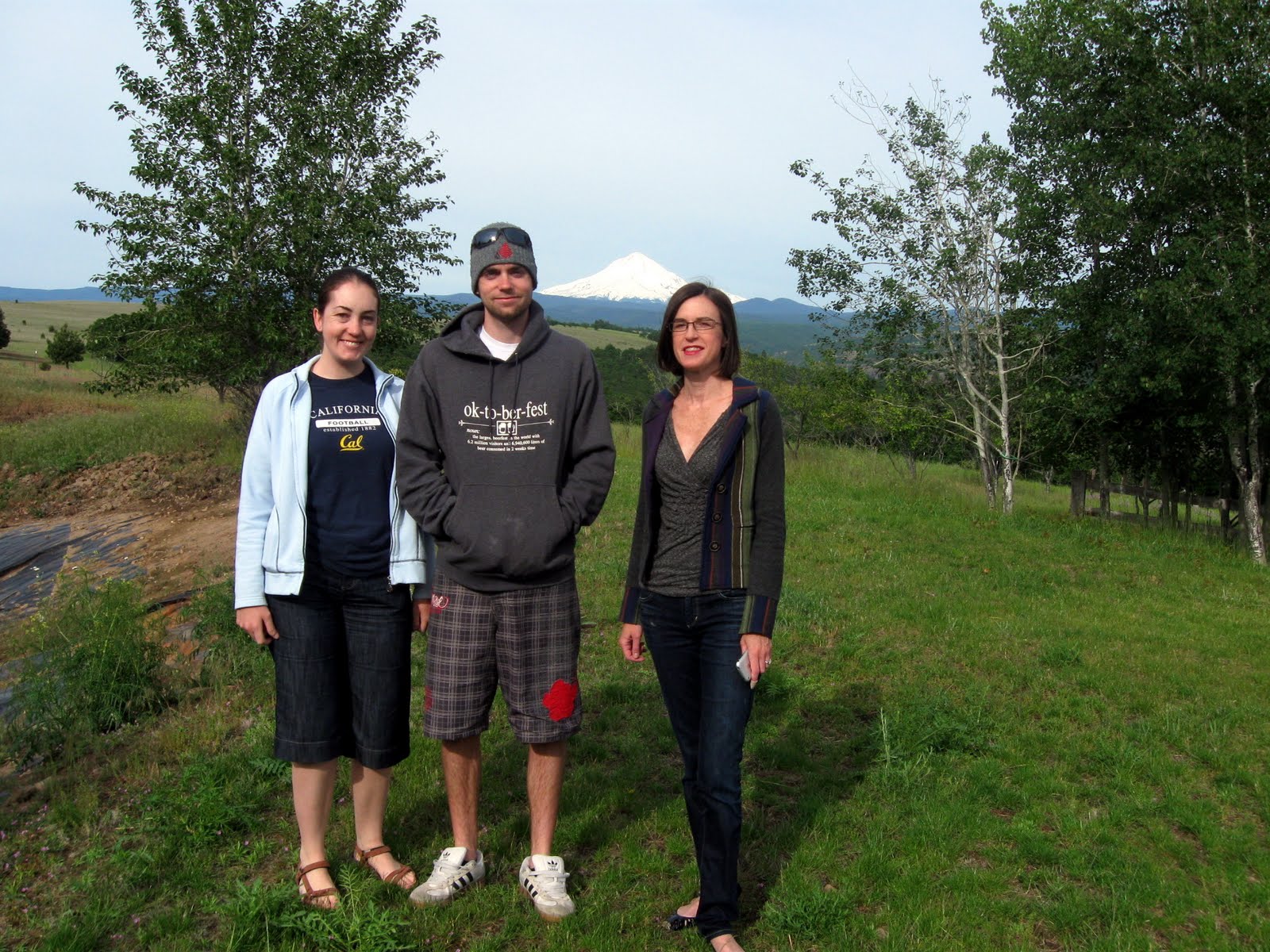
Mt. Hood as seen from "The Ridge"

Sometime during college I heard a statistic regarding the provenance of the various undergraduates at UC Berkeley with me. Inevitably, I will misquote the exact figure, but let's say that something over %50 of the students there had at least one parent born outside the United States. While this great melting pot/tapestry of a society we live in is both made more beautiful and strong by this fact, it actually puts me in this very boring-sounding minority: both my parents, in fact, all of my grandparents, were born in this country. And even when we do trace my roots back to Europe, I come from decidedly white stock: England, Ireland, Norway. Incredibly, this has given me a bit of an inferiority complex. I can't talk about learning recipes from the far-away country where my grandmother grew up (unless you count Nebraska), and my heritage doesn't include any stories about the "old country" as it were. Maybe it's because I live in California, the melting-est melting pot of them all, but it makes me decidedly weird to be able to say this: not only were all of my great-grandparents born in this country, but most of my great-great grandparents were as well! (I think one or two may have been from Canada, but I'm not sure at this point when the "Canadian line" met up with the American side).

Years ago I decided to start thinking about this as the cool fact it is, rather than something to be ashamed of. And, it is definitely a privilege to also have access to names, photographs, and even biographical information of ancestors of mine going back six or more generations. My great-great-great grandparents on my father's side were Remembrance and Katherine. What names! On my mother's side, my uncle has traced our family back to the Revolutionary War, when two brothers, William and Robert, were on opposite sides. William was a loyalist, and eventually fled to Canada, where his descendants stayed for a while. He is the brother I'm descended from. A loyalist to the crown!

Slightly more recently, a young Norwegian man named Lewis Anderson was pretty much kidnapped by his sisters and brought to live in north-central Oregon. He met a girl named Carrie, and together they built a homestead in a place called Pleasant Ridge and raised four children: Oscar, Lambert, Mabel and another girl whose name starts with E. Mabel is my great-grandmother. She married Samuel Meeker and their children were Helen, Doris and Earl. Earl married Mary Alice and they are my grandparents. All of this happened up on Pleasant Ridge, surrounded by scrub oak woods and wheat fields. This past weekend, I had a chance to see where I came from. And, looked at the right way, it's as amazing as anything else.


The "A-Frame" and in the distance, a barn

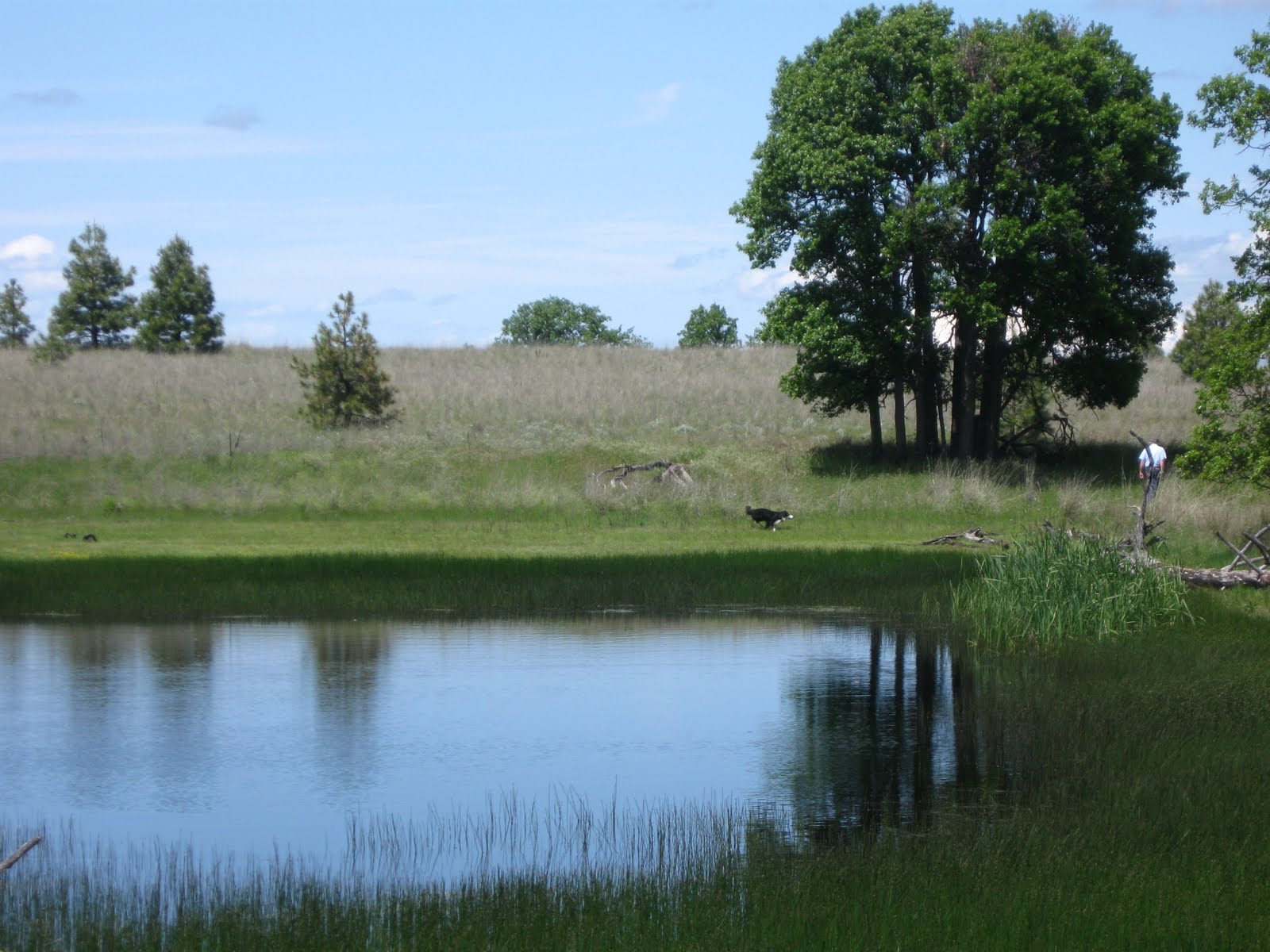
Lang's Pond


The diversity of flora on Pleasant Ridge

At the Anderson Homestead

Of course, the very most wonderful fact about this whole story is that Lewis and Carrie Anderson (again, my great-great-grandparents) built a homestead on Pleasant Ridge. There was nothing there but pine trees and views of the mountains, but like all those folks you hear about on the Oregon Trail, they built a life from almost nothing. Besides their house, they had a barn, a granary, various sheds (to my left in the picture), a root cellar and a blacksmith's forge. They cleared their land, farmed it, raised four children, and set events in motion that lead directly to me typing this today.

Anderson Homestead, pond in the distance

The best part of my visit was visiting this old piece of land, which has belonged to my family for over 120 years (the construction date on their house says 1895, but I know they lived there for 5 years before it was built).

Lambert Anderson's House

Lambert's house is reached via "Library Road" going southeast-ish from the original homestead. It's still standing, but that could change any time now. Inside, one can still find remnants of carpet, linoleum and their window coverings. It's like archaeology! Lambert would be my great-great uncle, so I am not his direct descendant. Lambert's wife, Edith, kept lots of books, and the children on the Ridge would walk to her house to borrow them, so she was the local librarian of sorts, and that's how "Library Road" got its name.

Lambert's Barn


Lambert's Barn

View of Mt. Hood from Lambert's Home

So here I am, exploring the land my family has owned continuously for five generations. We were treading paths followed by the childish feet of my own grandfather, who is long ago passed. The land was farmed by my great-aunts and uncles. They saw these gorgeous views, which have not been (nor, I hope, ever will be) obscured by modern buildings and highways. They breathed this air. And, looking out on all this, I could feel that there were ghosts there. They weren't mean or scary ghosts; they weren't even the kind of ghosts that try to influence the physical world. But they were there. The air around me was pregnant with history and memory. There was a kind of vibration, an energy, just outside my ability to feel it, reminding me that this is where I come from. This is my heritage. This land. The people who poured their whole lives into it that their children and children's children might go on to live and thrive and produce me.


Anderson House (built 1895)

Here's the house that Lewis and Carrie Anderson built. My grandfather donated it to the city of The Dalles as a permanent museum (to avoid its being burned down in a grass fire). Most of the inside is decorated based on educated guesses and some help from my great-aunts when they were still living. However, the spinning wheel inside did belong to my great-great grandmother, Carrie, which I find just splendid.

Tearing Down the Duck Blind

Since the land is still farmed, some real work must still be done. The trip involved a great deal of reconnaissance of the hundreds of acres of property, checking on wheat crops, trees stands that my uncle hopes to harvest for timber, and dealing with the consequences of hunting (see photo above). This structure is built next to a pond so "hunters" can shoot elk and deer from the trees when they come to drink. Not very sporting! My brother tore it down using mostly a pry-bar and his biceps.

Cousins, descendants of the wheat farmers (six others not pictured)

Mine is the first generation of my family since before the turn of the century to not grow up farming wheat on Pleasant Ridge, near The Dalles, OR. As a child, I heard stories from my mother about driving the hay trucks and being out next to her dad riding on the combines. Though the land is still farmed, my mom and uncle lease it to someone else and get a part of the profits from the sale of wheat or barley.

I stand to inherit part of this land some day. I have a lot of choices about what I can do with it. My cousin has some land, but she doesn't farm it and instead gets a little money from the government to do nothing with it and allow it to go back to its natural state (pine forest). I could build a house on it, but not a farm. I won't pretend that I could somehow manage a fully functional, self-contained farm. Or, like my mom and uncle, I could lease the land to someone to grow wheat. At the very least, I would love to continue the tradition of having this land to come back to. The memory and knowledge of the place are only kept alive as long as we have interest in them, and I don't intend to squander the remarkable gift of history my ancestors have left me.